


We’re employee-owned, every team member you work with brings the mindset of a business owner.

Alan Coleman, CEO


Wolfgang Digital is an equal opportunity employer committed to fostering an inclusive workplace


Wolfgang Digital is an equal opportunity employer committed to fostering an inclusive workplace


The beginning of this month was a financial results bonanza as the entire big tech ecosystem released its Q1 earnings. The media stories focused on double-digit growth and the eye-watering investments being made in AI.
Here at Wolfgang, we were crunching the numbers on a much more interesting story hidden within the financial results. That story suggests that Meta will take the crown as the largest advertising platform on the planet… and they’ll do it within 12 months.
To tell the story, we need to first nerd out on the numbers, and we’ll then explore just how Meta has achieved this and what it means for advertisers.
Alphabet is the bigger company by total revenue, but its income comes from three sources:
For our purposes, only advertising matters - and that generated $77B in Q1 2026.
Now, unlike Meta, Google generates some of their traffic via third-party websites such as the Google Display Network. They are essentially renting out this space, and that carries a Traffic Acquisition Cost of $15B. Only by removing this cost can we get a true view of the economics of their ad business.
That gives us a figure of $62B.
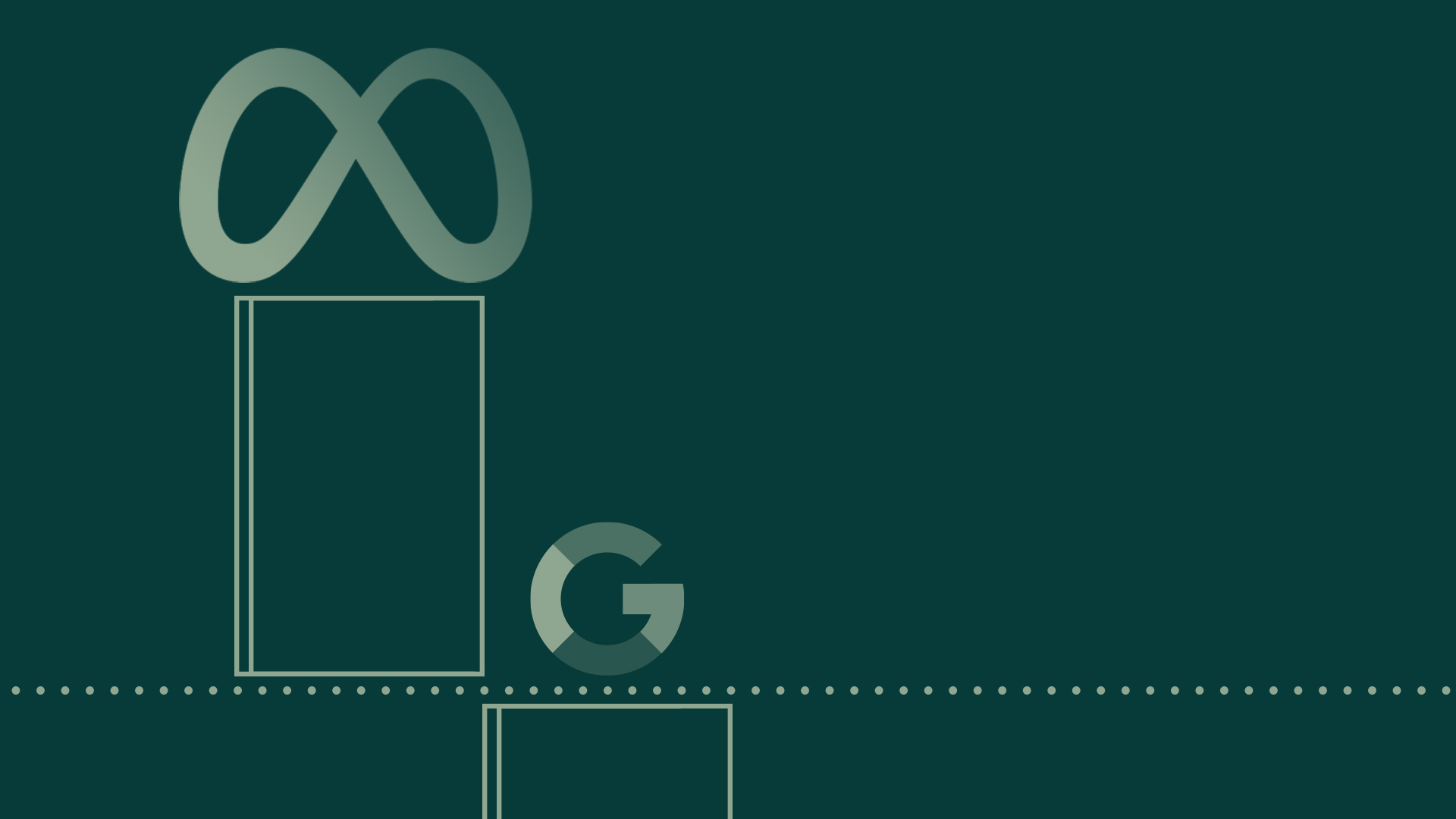
Thankfully, the Meta business is far less convoluted, and they own the land they serve ads on.
Their revenues for the same period were $56B.
We were surprised to see how close they were to Google, and they’ve been narrowing that gap over the last few years with strong YoY growth.
That realisation blew our little minds. We knew Meta was doing well, but it hadn’t occurred to us that they were on a path to becoming the biggest advertising platform on the planet so soon.
Google always seemed like a safe bet; with their large ecosystem of products, analytics and reporting solutions that focused on last click and their position at the bottom of the funnel, hoovering up those sales.
Well played, Meta, but how did they do it? How did they upend the King of online advertising? Google had a $16B head start by the time the Facebook ads platform was launched.
At Wolfgang, we believe that there are 3 key reasons:
The Meta party line is that AI is making the ad product better. But Google is using AI too and has been for years.
What’s working so well for Meta? The answer, we believe, is that AI is moving the conversion further up the funnel. Google built their business hanging out at the bottom of the funnel, and now Meta has cut off their supply.
They are drinking Google’s milkshake!

The key change is that we no longer target ads based on demographics, interests, etc. AI allows us to target based on intent. Once you get that right, you win the conversion before that user ever needs to search.
Mata’s AI has learned patterns that no human media buyer could ever detect - like the fact that a particular type of person who watches 40% of a Reels video on a Tuesday evening is 3× more likely to purchase a skincare product in the next 72 hours than someone who clicked the ad directly.
AI is helping advertisers convert people further up the funnel, and the longer people spend on Meta’s platforms scrolling, clicking, sharing, etc., the smarter the AI is becoming.
The most consumed content format on the planet. TikTok pioneered it, but Meta quickly pivoted in this direction and was helped, no doubt, by TikTok’s regulatory problems in the US. Meta has fed our ferocious appetite for this type of content and commercialised it via Reels, which now accounts for an estimated 50% of time spent on Instagram.
Combined with point 1 above, you get the perfect advertising flywheel.

A bit less glamorous, but very important. One of Google’s advantages has been its role as the gatekeeper of measurement via Google Analytics. They essentially get to mark their own homework and that of Meta, where they are incredibly harsh.
Our own recent Online Retail Report showed that 59% of revenue comes from search and only 4% came from social… according to Google Analytics. Very harsh and not a reflection of reality.
CAPI (conversion API) is Meta's server-side tracking solution. It has allowed Meta to fill in the data gaps and get a clearer view of conversion data that would have been otherwise obscured by cookie blockers, Safari issues on Apple devices, etc.
Our internal data from CAPI shows that the Google figure of 4% could actually be as high as 28%. Again, this data is used to feed Meta’s AI, and the flywheel keeps spinning.
The question for every marketing team right now is a simple one: are you capitalising on what is about to become the largest advertising platform on the planet?
For most advertisers, the honest answer is no. Social media investment has historically been underweighted relative to its actual value - precisely because measurement frameworks built on last-click attribution made it look less effective than it was.
Google isn’t going anywhere. Search remains a powerful channel and will be for years. But the centre of gravity in digital advertising is shifting, and the brands that recognise it early will have a significant advantage over those that don’t.
The biggest advertising platform on the planet is about to change hands. The question is whether your strategy reflects that yet.


Partner with a 6x Best Global Agency Winner that's as invested in your growth as you are.


