


We’re employee-owned, every team member you work with brings the mindset of a business owner.

Alan Coleman, CEO


Wolfgang Digital is an equal opportunity employer committed to fostering an inclusive workplace


Wolfgang Digital is an equal opportunity employer committed to fostering an inclusive workplace


Google rarely tells you where search is going. It just starts building it, quietly, inside the tools developers use every day. If you know where to look, those tools read like a roadmap.
So I went looking 👀
The clearest signal I found is one almost nobody is talking about: Google has started giving your website a score for how well a robot can read it.
It sits in Lighthouse, the free auditing tool every web team already runs, right beside the Performance, Accessibility and SEO scores marketers obsess over. The new category is called Agentic Browsing. It arrived in May, it is still flagged experimental, and it does not grade you out of 100. It hands you a pass ratio, two out of three, say. So, Google now has an official, named measure of how ready your site is for AI agents. That has never existed before.

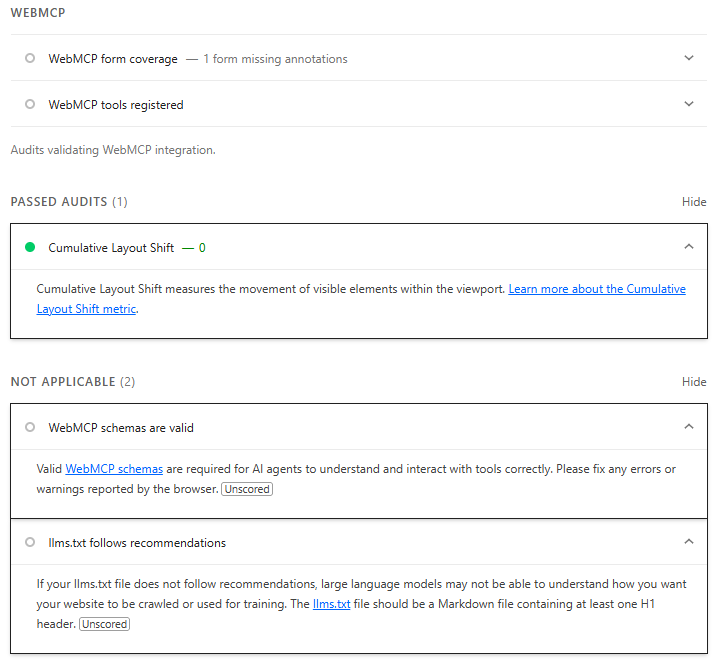
Here’s why it matters to anyone who cares about traffic. Across our clients, organic was down about 12% year on year in the first quarter. Plenty of marketers are quietly assuming that is on them. It mostly isn't. It is the first visible crack of a much bigger shift, and Google's own dev tools are telling you what comes next.
There is the web humans see, interactive and stuffed with JavaScript. And there is the web machines read, on behalf of the human who asked. The "user" of your website is increasingly not a person. It is an agent, weighing you against three competitors and acting for someone else. We have been calling this the Great Decoupling: your influence and the click you can count are drifting apart. The Lighthouse score is Google admitting it, in code rather than in a press release.
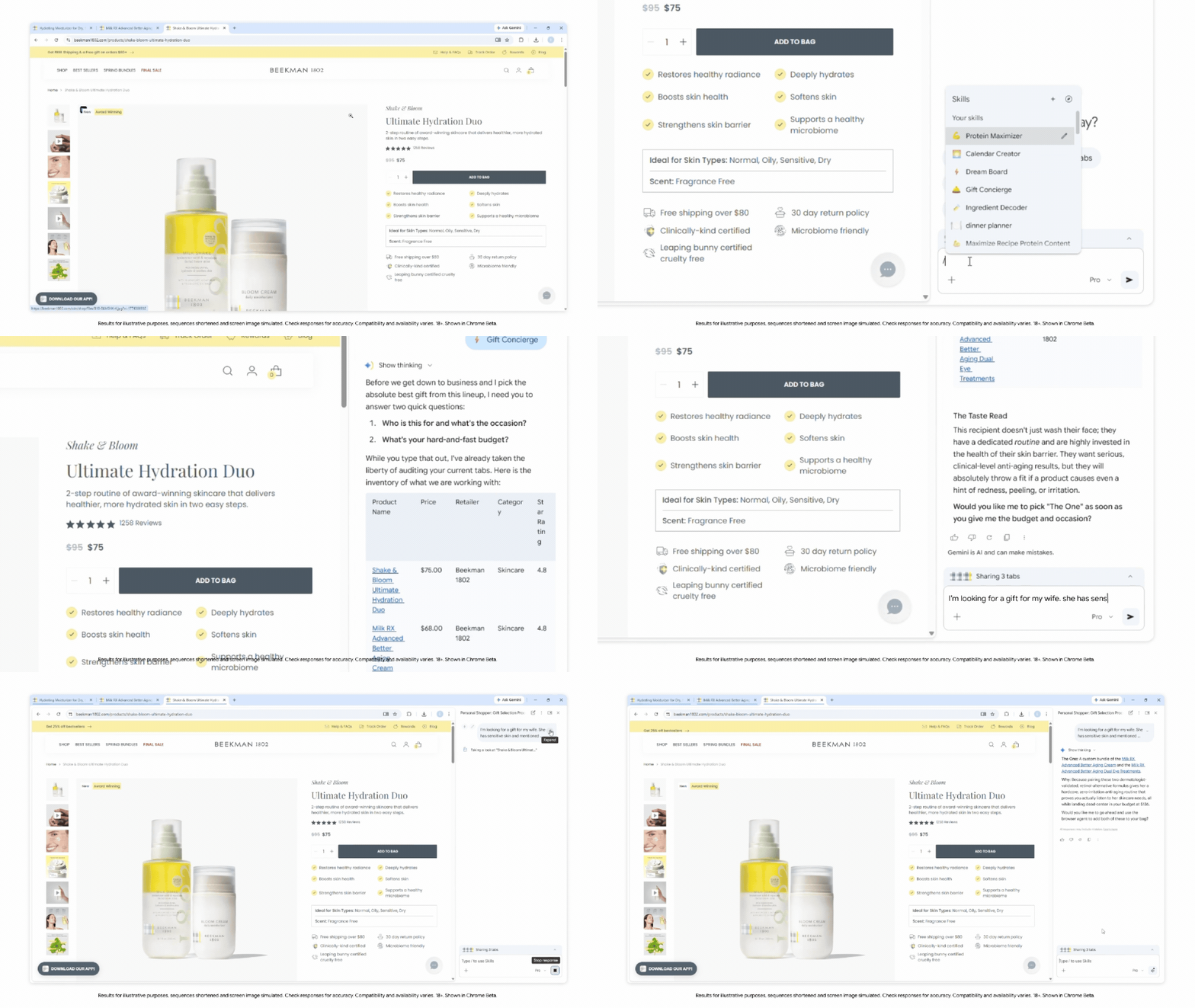
In April, Google launched Skills in Chrome. If you have come across Skills in Claude, it is the same idea: you save an AI prompt once and rerun it on demand, here fired at any web page with a slash. Save "compare these three on spec and price," run it across whatever tabs are open, read the answer in the sidebar. The comparison never touches a results page. It isn't live in Ireland yet; Europe is waiting on the regulators, but the direction is there. If your product page buries its key facts behind tabs and accordions, you are losing a comparison you never knew was happening.
OpenAI and Stripe's Instant Checkout has let people buy inside ChatGPT since last September, starting with US Etsy sellers and rolling out to over a million Shopify merchants like Glossier and Vuori. At the NRF retail show in January, Google answered with its own open standard, the Universal Commerce Protocol, co-developed with Walmart, Target and Shopify, that lets people buy inside Google's AI Mode and Gemini without leaving the page. McKinsey reckons agentic commerce could mediate $3 to $5 trillion of global spend by 2030. In a channel ranked on relevance rather than ad spend, you cannot outbid your way to the front. Your shelf position becomes the quality of your product data: clean titles, honest prices, live stock. If an agent can't understand your product, it can't recommend it, never mind buy it.
Most AI crawlers don't run JavaScript. They read the raw HTML your server returns and nothing else. If your prices and product schema only appear after a tag manager fires, a browser sees them fine and an AI crawler sees a blank page with no words on it.
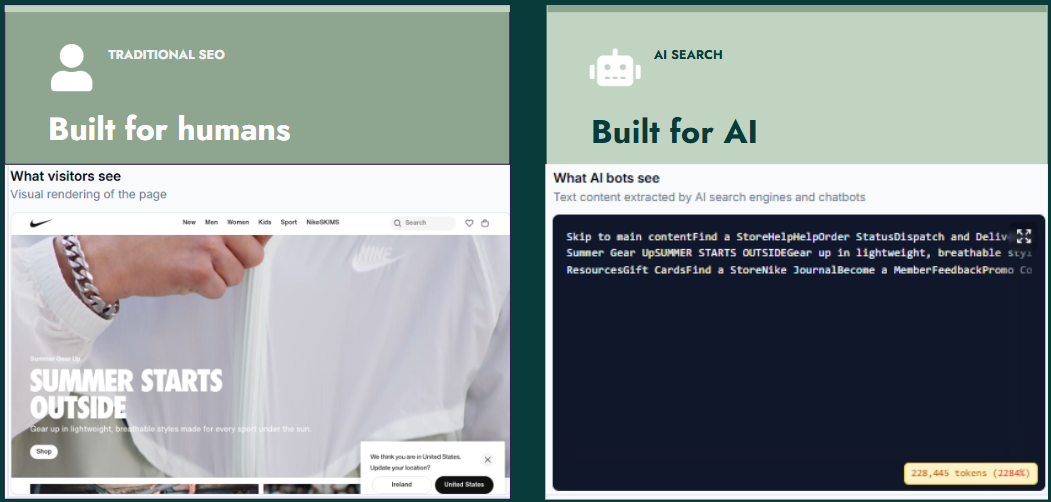
Server-render the things that matter, put your structured data in the HTML, and check what the bot sees, not what your browser shows you.
One of those Lighthouse checks looks for an llms.txt file, a little markdown map of your site. Google's own John Mueller has said plainly that it isn't used for search, no major AI provider has confirmed they read it, and the bots aren't even requesting it in server logs. It has the whiff of the old keywords meta tag, the one SEOs stuffed until Google ignored it. Our advice is you can create one if you like as a test, it costs nothing. But don't bank on it changing anything just yet.
The checks worth your time are the dull ones:
They help humans and machines at the same time, so the work pays twice.
The traffic didn't vanish. It went dark. "Dark direct" is the bucket of visits that land in your analytics as direct when they were nothing of the sort, and it has been swelling for years: consent banners that block tracking, privacy browsers, referrers stripped in transit, sessions bounced through apps. AI answers are the newest and fastest-growing source. Someone reads about you in an AI response, types your name straight into the bar, and arrives with no trace of what sent them. A lot of that misattributed traffic is organic that lost its paperwork. Across thirteen client accounts we ran the numbers on, a median of almost 60% of "direct" was misattributed, and correcting it moved €1.28 million of revenue back to organic, where it belonged.
Well, the SEO’s job has widened. Classic SEO still earns its keep, especially when it’s part of an integrated cross-channel strategy with content aligned across your website, social, YouTube and beyond - cementing your authority. But there is a second site to build now, the one machines read, and most brands are only building one of them.
So the work has changed. We focus on making your site 'AI-ready' by prioritising the structural elements that both humans and machines need to see. Instead of leaving your core data buried in complex scripts, we bring it directly into the site's foundation so it’s unmistakable to any AI agent that crawls it. We treat your product data as a high-value growth asset, something that needs to be perfectly clear to the bots that are now recommending your brand to customers.
And we've made visibility a core KPI, not a vanity one. Because the click has stopped being a reliable measure of the work. Between zero-click results, dark direct and consent gaps, last-click attribution now misses most of what SEO does, and most of that work happens off your site: the mention, the citation, the recommendation that shapes a decision long before anyone lands on a page. So we track how often a brand shows up and gets cited, across the classic results page and the AI engines both, because that is where the value is being created now.
Google won't send a memo when search changes. It’s already sent the signal. If you'd like to know how AI-ready your site is, talk to us about AI Search and GEO. We'll show you where you stand and what to fix first.


Partner with a 6x Best Global Agency Winner that's as invested in your growth as you are.


