


We’re employee-owned, every team member you work with brings the mindset of a business owner.

Alan Coleman, CEO


Wolfgang Digital is an equal opportunity employer committed to fostering an inclusive workplace


Wolfgang Digital is an equal opportunity employer committed to fostering an inclusive workplace


For twenty years, SEO measurement rested on one dependable relationship: if your visibility in search grew, your traffic grew with it. Every report, every target, every budget conversation assumed that link. In the past year, across our client base, that link has broken. Organic traffic is down 12% year on year, while for 68% of those same clients, visibility is up.
We're far from the only agency seeing this, and the causes are well-documented:
We covered the mechanics in depth in our recent webinar - you can watch it back here.
This post is about the consequence.
Because when the metric you report on stops correlating with the work you do, you have two options. You can keep reporting it and spend every review meeting explaining it away. Or you can change what you measure. We're changing what we measure.
Here's the real problem with a falling traffic line: it can't tell you why it's falling. The same traffic report can be hiding at least four completely different situations:
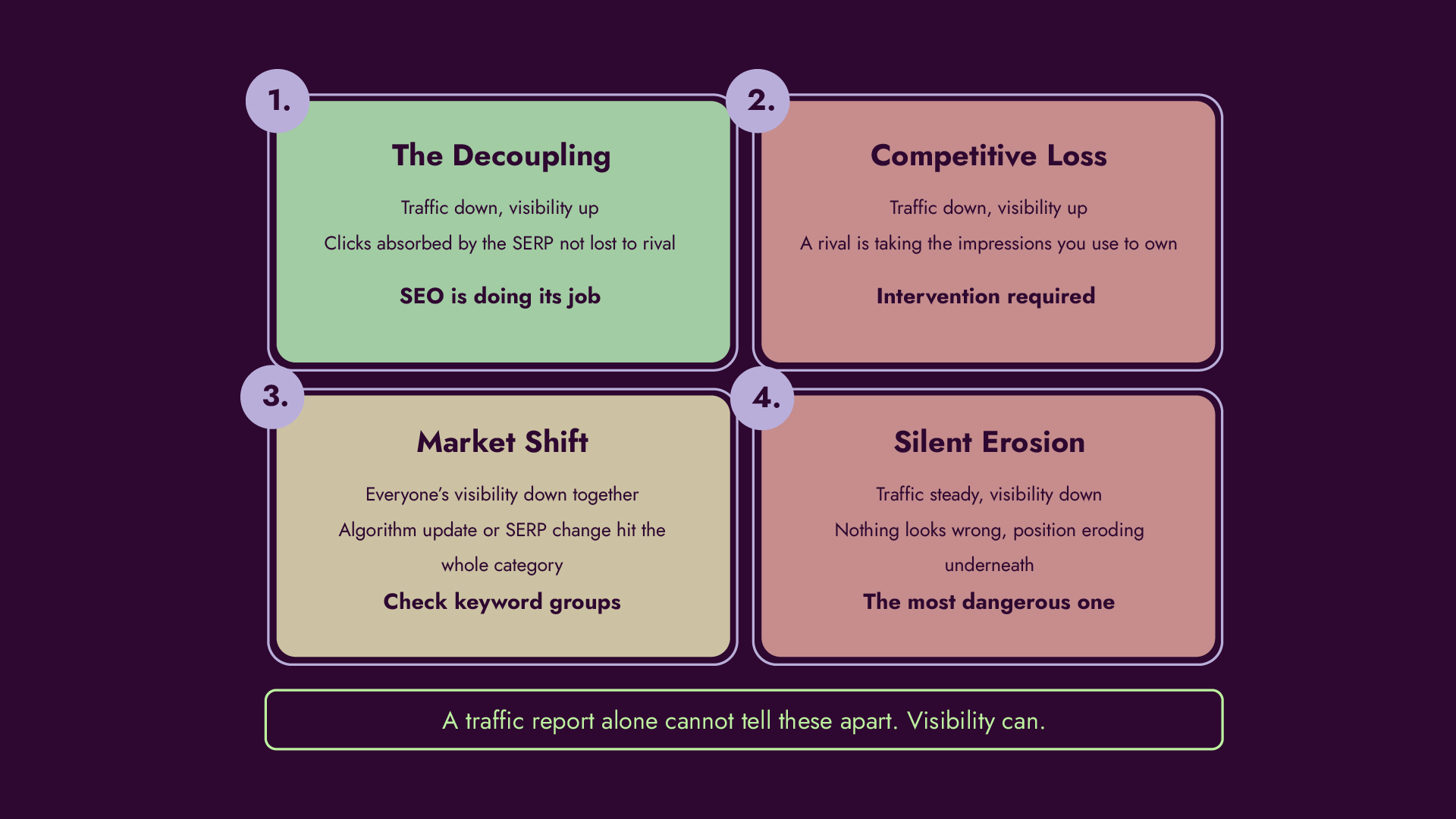
Four different stories. Four very different responses required. And a traffic report cannot distinguish between them. That's the case for visibility measurement in a nutshell: it tells you which story you're in.
Two metrics do this work for us, both from properly configured SEOmonitor campaigns.
Visibility measures the share of available organic impressions your website captures across a defined keyword set, weighted by ranking position and search volume. A first-place ranking on a high-volume keyword moves it a lot; a tenth-place ranking on a niche term moves it a little. It's a clean read on your own performance against your own ceiling.
Share of Visibility applies the same calculation to every domain ranking for those keywords, so you can see your visibility relative to your competitors', tracked over time. The simplest way to hold the distinction: Visibility is your score, Share of Visibility is your league position.
The league position is the one that changes the conversation. Traffic and rankings are outputs. Share of Visibility is market position: what proportion of your addressable search market you own versus the competition. That's a language any board already speaks, because it's how they think about the business itself. And it separates the two stories that a traffic graph blurs together. If your traffic is down while your Share of Visibility grows, the clicks went to the SERP, not to a rival, and the work is doing its job. If your Share of Visibility is shrinking, you have a genuine competitive problem, and now you know precisely where: which keyword groups, against which competitors.
Share of Visibility only works when the campaign underneath it is built properly. Three things have to be true:
We audit all of this before Share of Visibility becomes a primary KPI for any client.
The second measurement layer covers the surfaces where there are no rankings at all. Using our AI visibility platform, we track how often a brand appears in AI-generated answers across a set of high-intent prompts built around its actual buying questions, how it's positioned and with what sentiment, and how all of that compares to competitors. Presence and competitive presence: the same score-and-league-position thinking, applied to ChatGPT, Gemini and the rest.
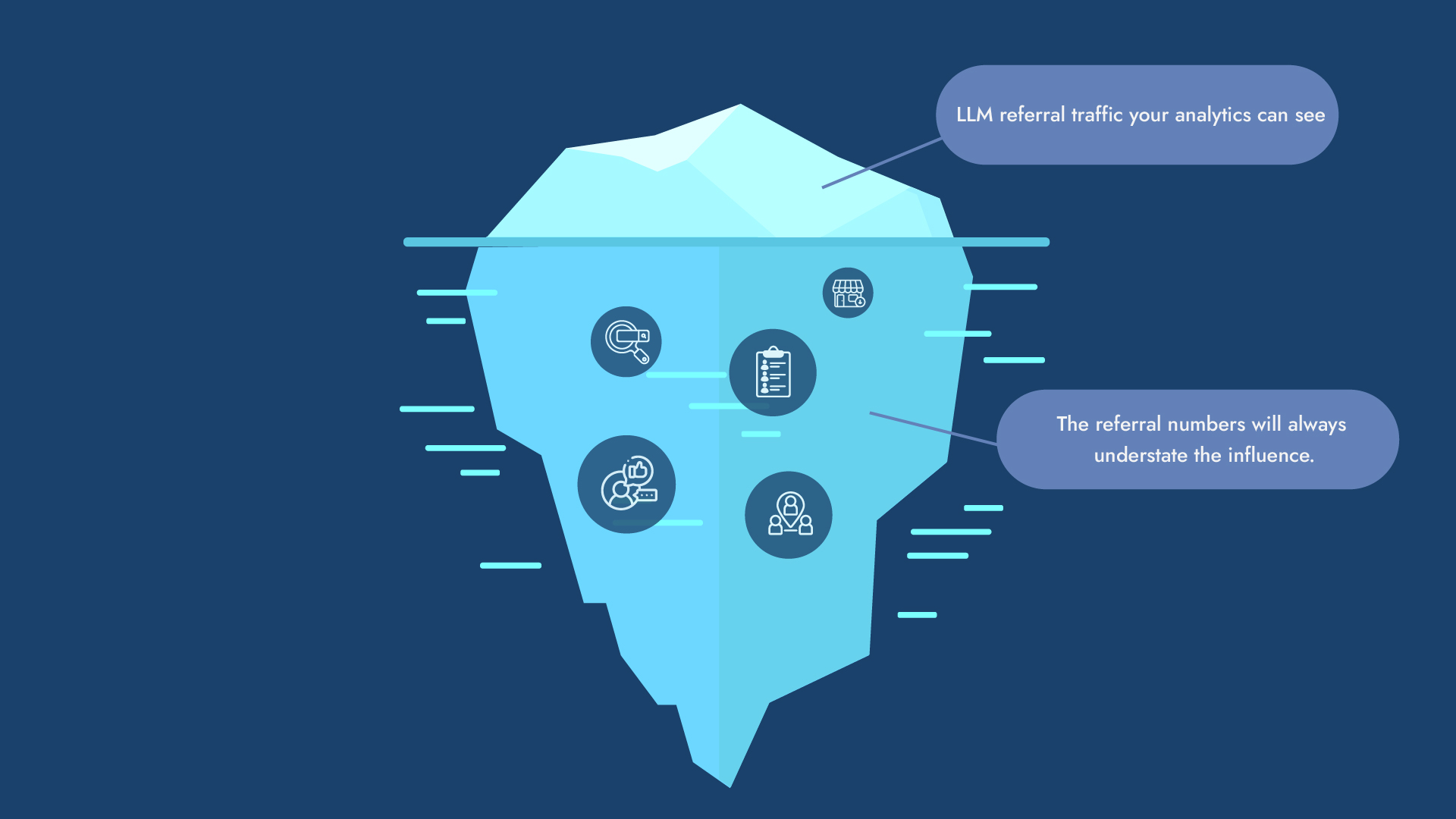
We don't expect referral traffic from LLMs to grow into a major traffic source, and we're suspicious of anyone promising it will. An AI search isn't a search that ends with a click; it's a conversation that ends with a recommendation, and in our view, that journey is more likely to finish in a direct visit or a branded Google search days later than in a tidy referral your analytics can attribute.
The traffic that does click through is worth having: across the clients we're tracking, LLM-referred visitors are converting at roughly three times the rate of organic traffic, because they arrive with their questions already answered. But the referral numbers will always understate the influence. Most of the value created inside an AI conversation shows up somewhere your analytics can't trace it back. Which is exactly why we measure presence in the answer rather than waiting for clicks that were never coming.
In practical terms, for most of our clients, Visibility and Share of Visibility will become the primary SEO KPI over the next 6 to 9 months, with targets set against them. This isn't moving the goalposts. The pitch itself has moved, and we'd rather measure the game that's actually being played. Revenue and leads don't disappear from reporting. We watch them as downstream metrics and look for correlation with visibility gains, rather than pretending GA4 can cleanly attribute them.
There's a second reason the attributed organic number can't be the verdict on SEO anymore: it's leaking. A customer whose journey starts with your ranking content might convert days later through a branded search, a direct visit, or a last-click PPC ad, and the credit lands on those channels. That’s what the dark direct data and the AI journey both show. So for some clients, directly attributed organic revenue may sit flat year on year while the channel is genuinely feeding growth elsewhere in the mix. If visibility is climbing on a carefully chosen set of entirely relevant keywords, the demand is being created. The attribution just isn't sending it home to the right address.
The deepest shift is in how we think about the channel itself. SEO used to be a direct response channel: rank, click, convert, attribute. It has become a discovery channel: one of the key touchpoints, alongside AI platforms, where your customers find, evaluate and shortlist you before any click happens. The pages that rank well in Google are very often the same pages the AI engines read and cite, so your SEO investment now feeds two engines instead of one.
Our responsibility is simple: maximise your organic visibility wherever your customers are searching. Google, ChatGPT, AI Overviews, all of it. That's the job now, and Visibility and Share of Visibility are how we'll prove it's being done.
If you'd like to know which of the four stories your own data is telling, get in touch. It's worth finding out before your competitors do.


Partner with a 6x Best Global Agency Winner that's as invested in your growth as you are.


