


We’re employee-owned, every team member you work with brings the mindset of a business owner.

Alan Coleman, CEO


Wolfgang Digital is an equal opportunity employer committed to fostering an inclusive workplace


Wolfgang Digital is an equal opportunity employer committed to fostering an inclusive workplace


Last October we published research on how Irish consumers were using ChatGPT to make purchase decisions.
This year we re-ran the study with Amárach Research and widened the scope. A nationally representative sample of 1,000 Irish adults, covering every major AI assistant rather than just one. Here is what came back, and why it’s relevant to your business.
69% of Irish adults now use at least one AI tool.
By comparison, CSO figures put AI adoption among Irish enterprises at 20.2%, falling to 17.2% among small businesses.
The Irish consumer has moved three times faster than the businesses selling to them.
Much of the conversation about AI in business has focused on productivity, headcount and cost. Those are fair questions, but they’re distracting people from something more immediate. Customers are already using AI to decide what to buy, and who to buy it from.
Since we last ran this study, new tools have entered the market, and our familiarity with other tools has increased, so we wanted to get a handle on which tools were most widely used.
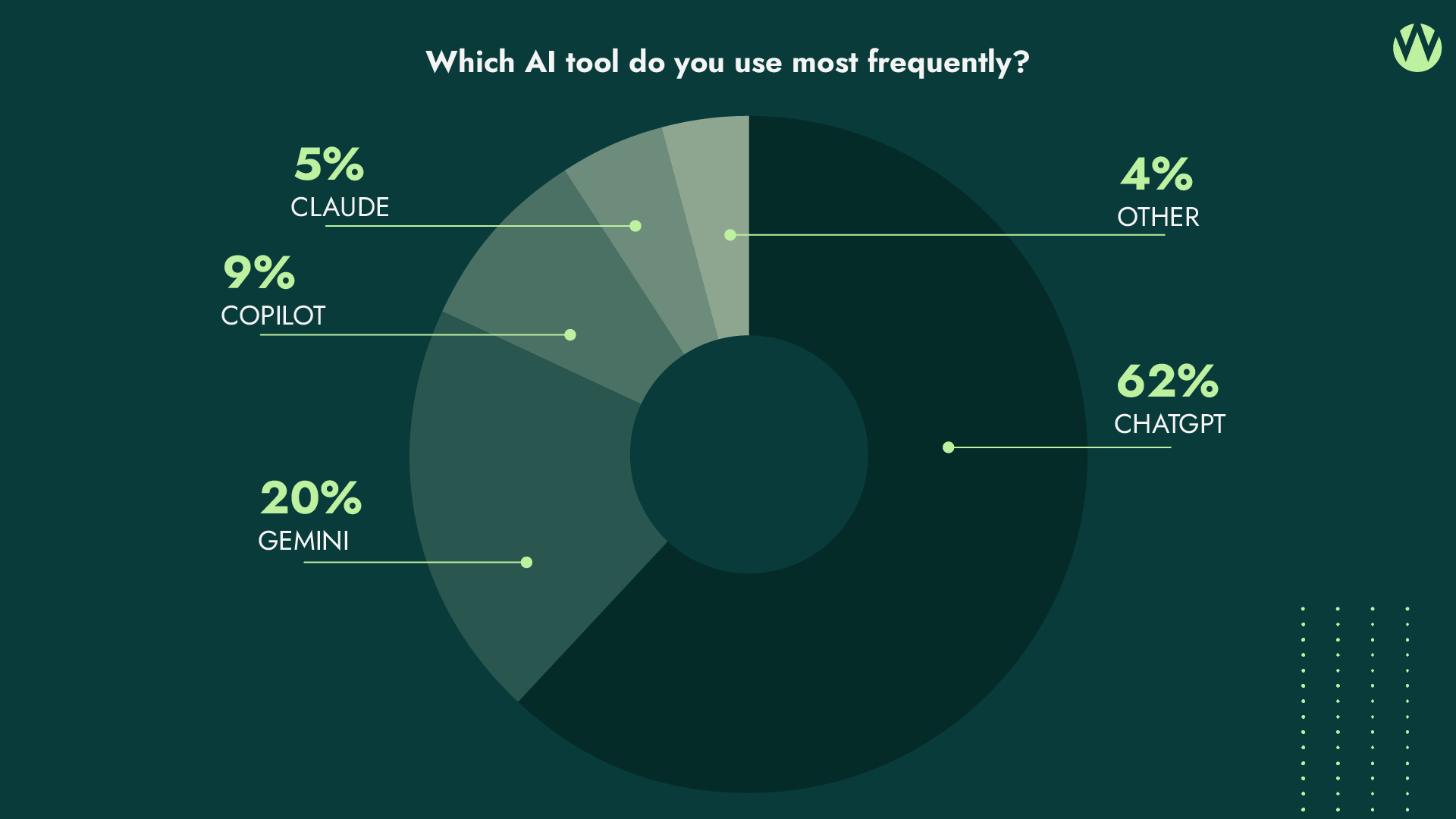
ChatGPT is winning the popularity contest amongst AI users. However, bear in mind that what we’re tracking here is active use as declared by each respondent. We can’t capture passive use of tools that are baked into Microsoft and Google, for example.
46% of Irish adults, roughly 1.9 million people, have used AI to research, compare or choose a product or service.
Of those, 56% went on to buy. That works out at 26% of all Irish adults, around 1.1 million people, who have bought something after researching it with AI.
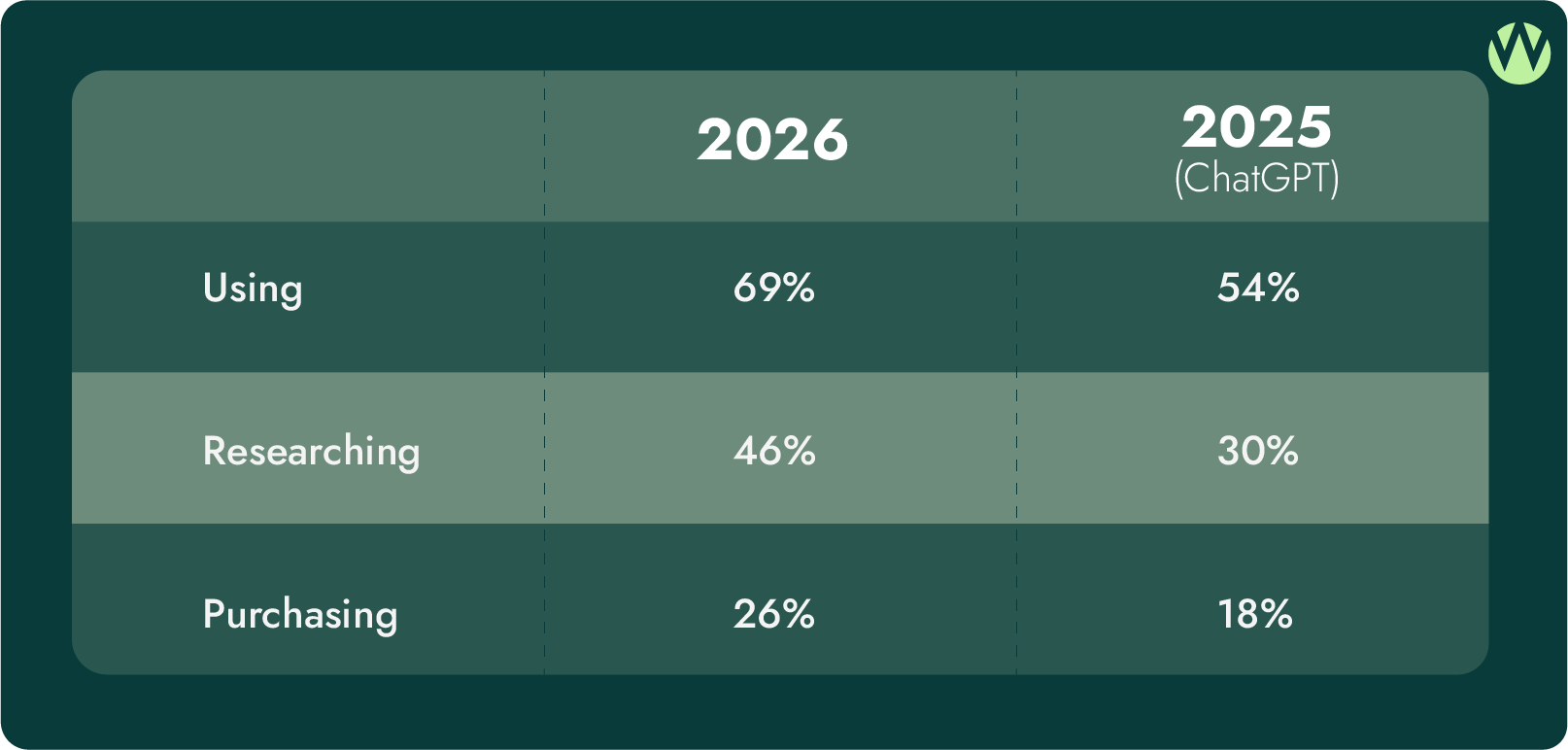
The comparison is not perfectly like-for-like: our 2025 study focused solely on ChatGPT, while the 2026 study covered all major AI assistants. Even with that caveat, the trend is clear. AI is becoming a meaningful part of the Irish customer journey.
26% of Irish adults say an AI tool has recommended a brand, product, or retailer they had never heard of. Among 18- to 24-year-olds, it is 43%.
AI is not simply helping consumers validate decisions they have already made. It is introducing them to brands they may never otherwise have considered.
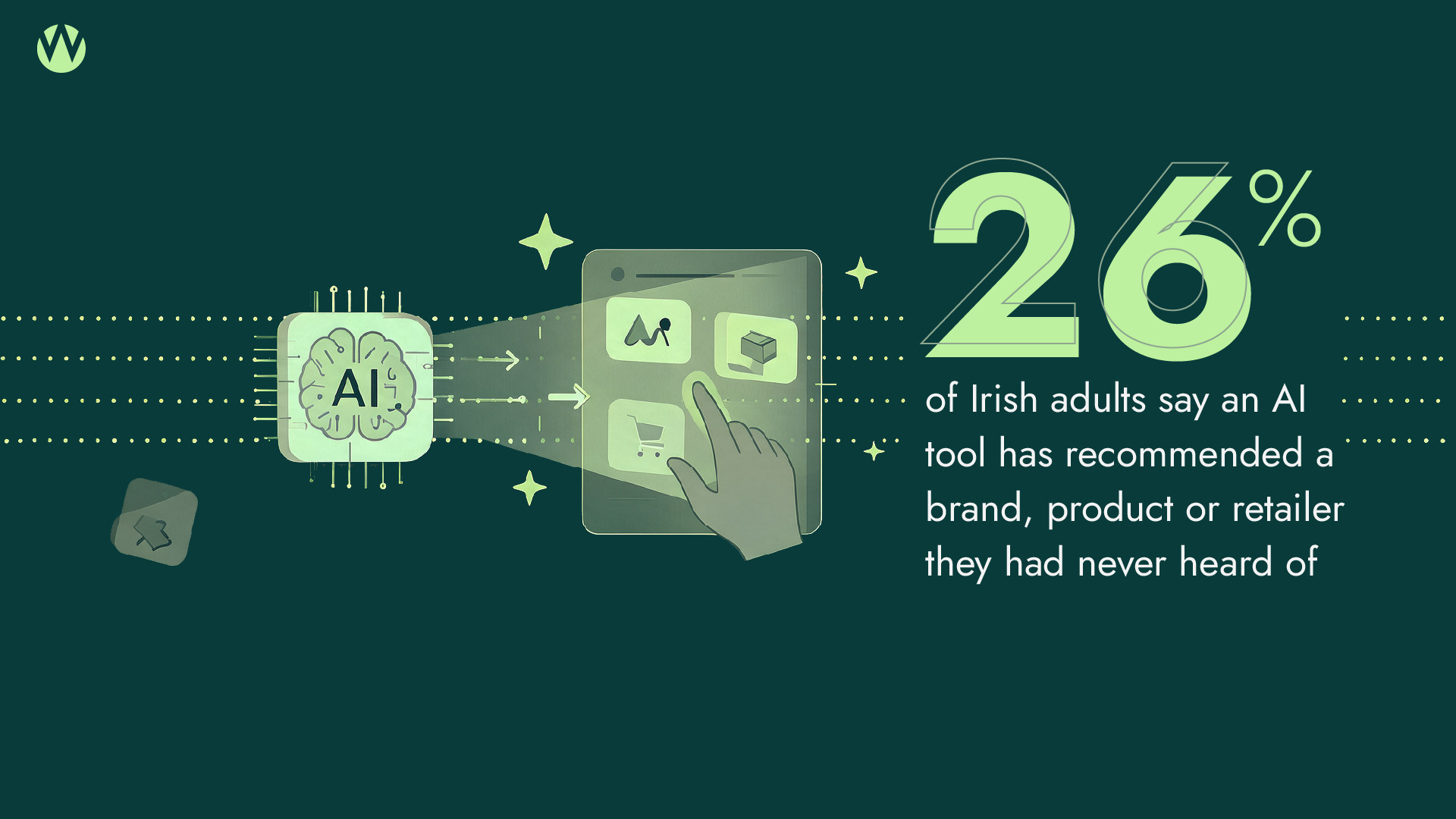
Around 1.1 million Irish adults have now been introduced to a brand by a machine.
In a single generation, brand discovery has moved from ads to algorithms and now to AI assistants. That leaves you with a simple question: when an AI assistant makes a recommendation, does it recommend your business or a competitor?
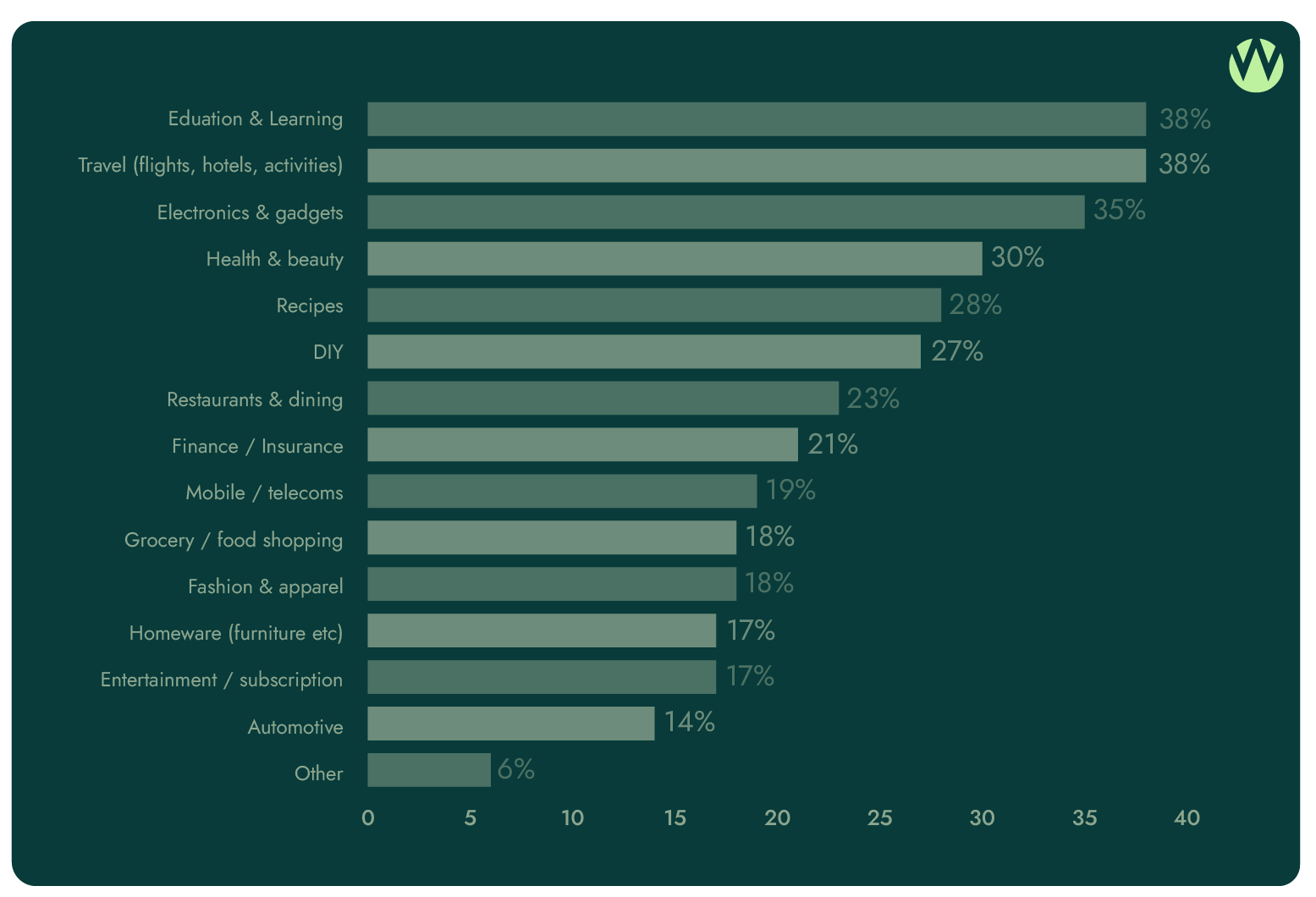
Consumers are using AI across a broad mix of categories. Education and learning (38%) and travel (38%), including flights, hotels, and activities, are the most common. They are followed by electronics and gadgets (35%), health and beauty (30%), recipes (28%) and DIY (27%).
Usage covers both considered purchases and everyday problems: from choosing an expensive device or planning a holiday to deciding what to cook for dinner.
Consumers are happy to ask AI for advice, but most are not yet ready to hand over their wallets.
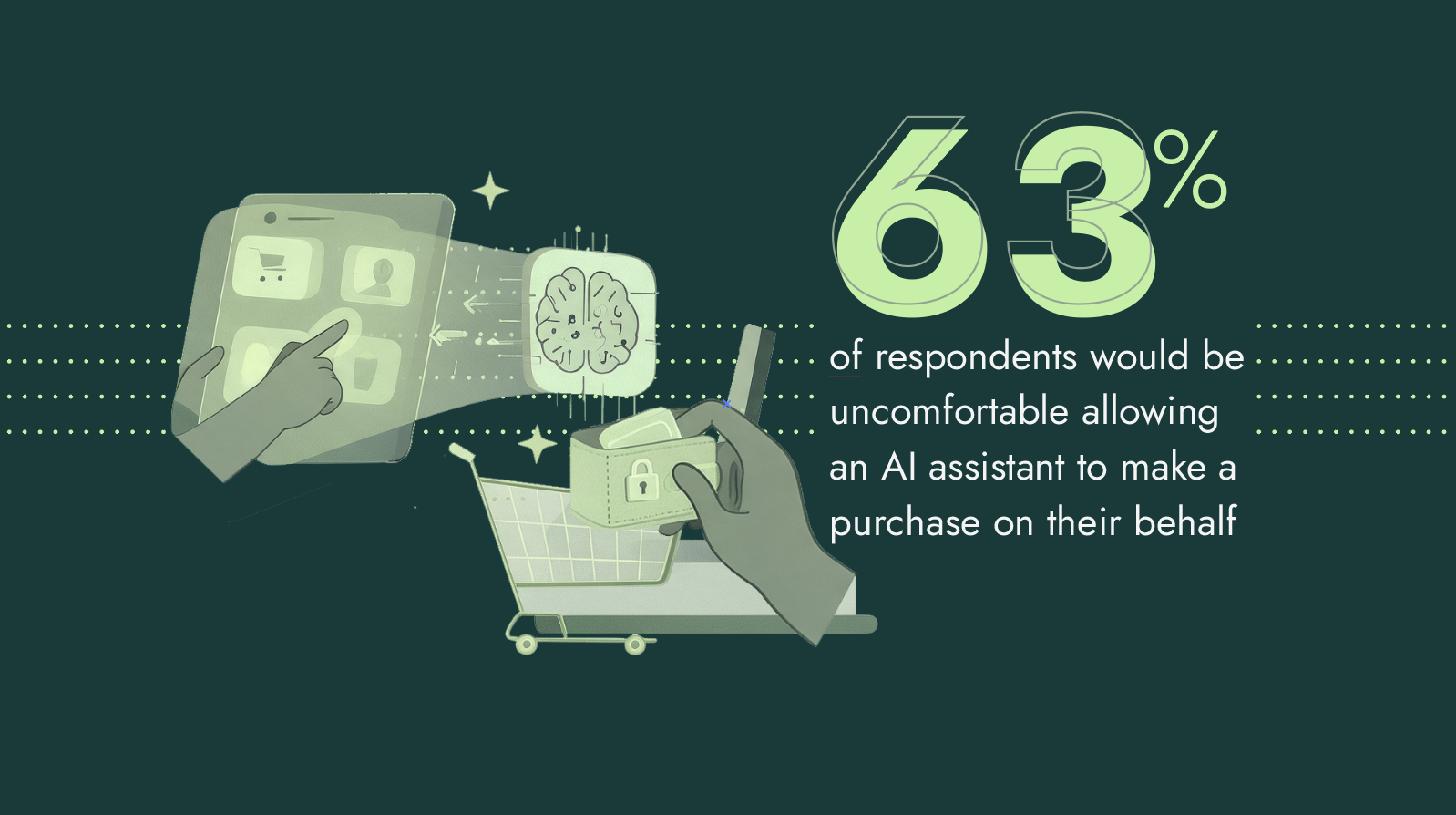
We asked respondents how comfortable they would be allowing an AI assistant to make a purchase on their behalf, based on criteria they had set.
63% said they would be uncomfortable, including 46% who would be very uncomfortable. Just 19% said they would be comfortable.
There is a clear generational divide. Comfort rises to 30% among people under 35 and falls to 6% among those aged 65 and over.
AI is helping us shop, but many of us are not yet willing to give it control of our wallets.
Some predictions estimate that agentic e-commerce will reach 20% of total e-commerce by 2030. I’ve been burnt by predictions like this in the past, so I’m less bullish. However, I’m under no illusions that things are changing, and while consumer trust might lag, it will catch up.
Your business now has two audiences: your customers and the AI systems they ask for advice. You are already optimising for the first. The opportunity is to start building visibility with the second.
We asked all 1,000 respondents where they usually start their research. 59% said Google. Retailer websites took 14%. An AI tool took 9%.
Google is still our front door to the web.
Among 18- to 24-year-olds, though, the picture looks different. 34% start on Google. 20% start with an AI tool. 20% start on social media.
This could be a signal of a future shift. This group is 18 to 24 today. In ten years, they could be the highest-value consumers in the market, and habits formed at 22 tend to persist.
BUT, never bet against Google and don’t underestimate how important it still is as the primary discovery channel that people are using today. However, don’t be under any illusions: Google is AI-powered too, with AI overviews appearing in 43-55% of all Google searches.
43% of Irish adults expect to use AI more over the next year.
Your customers already understand this technology. They use it regularly, and they increasingly rely on it to decide whether to buy from you or from someone else.
The question is no longer whether AI will influence your customers' journey; it is whether AI will lead customers to you.
Tracking and improving your business visibility across the AI ecosystem is the best step that you can take right now.


Partner with a 6x Best Global Agency Winner that's as invested in your growth as you are.


